Riding on a smile and a shoeshine
Riding on a smile and a shoeshine is a phrase that appears in the final moments of Arthur Miller's Death of a Salesman, spoken by the neighbor Charley at Willy Loman's grave. It distills the essence of the salesman's trade as Miller conceived it: a profession in which a man has no product, no craft, no fixed skill—only the force of his own personality, the warmth of his smile, and the polish of his shoes. The phrase is not merely a colorful idiom; it is the play's most compressed statement about the nature of Willy Loman's life and the source of his tragedy.
Origin and Context in the Play
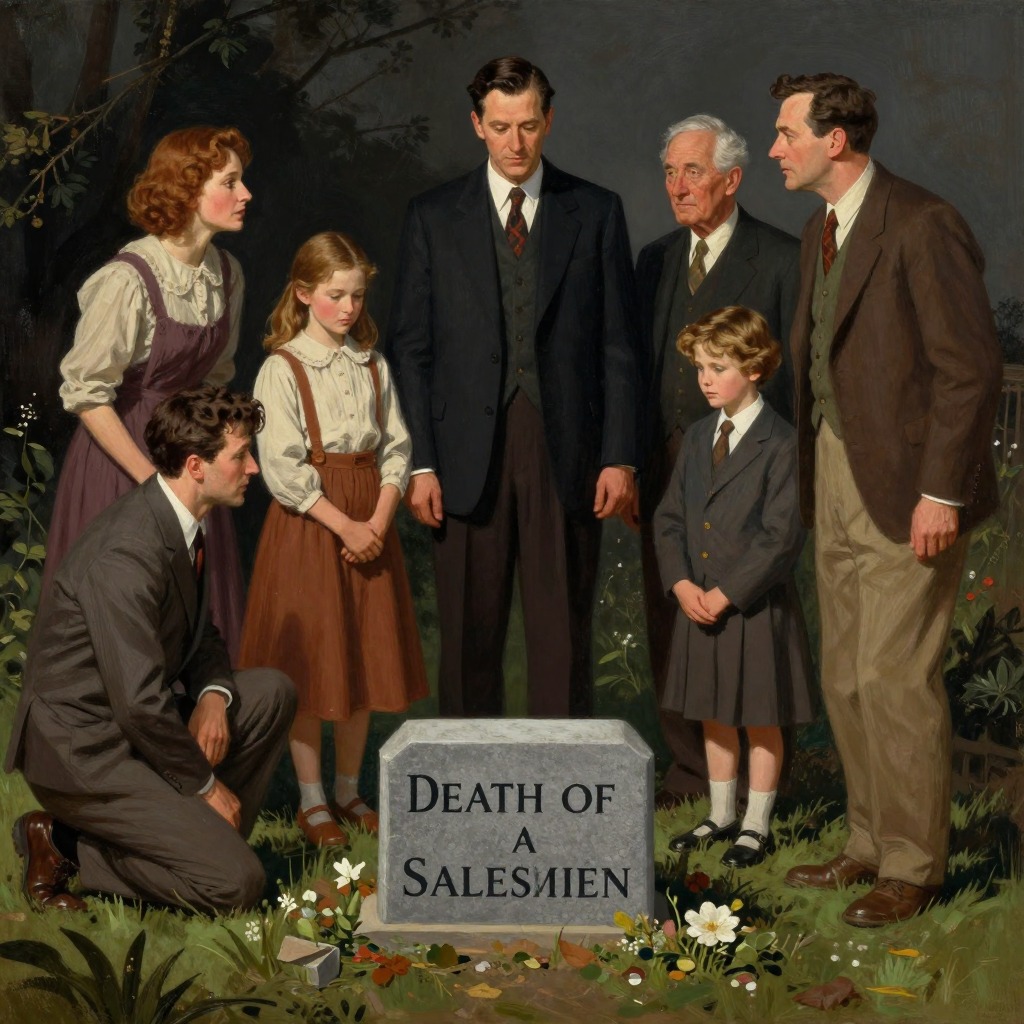
The line comes during the Requiem, after Willy's funeral, when Charley defends Willy against any judgment. Biff has just said that Willy "had the wrong dreams" and "never knew who he was," and Happy, still clinging to his father's values, insists that Willy "did not die in vain." Charley then speaks the play's most famous summation: "Nobody dast blame this man. You don't understand: Willy was a salesman. And for a salesman, there is no rock bottom to the life. He don't put a bolt to a nut, he don't tell you the law or give you medicine. He's a man way out there in the blue, riding on a smile and a shoeshine. And when they start not smiling back—that's an earthquake. And then you get yourself a couple of spots on your hat, and you're finished. Nobody dast blame this man. A salesman is got to dream, boy. It comes with the territory." The phrase "riding on a smile and a shoeshine" thus becomes the play's final, authoritative definition of what a salesman is: a performer whose entire capital is the goodwill he can generate, and whose collapse is absolute when that goodwill fails.
The Salesman as Performer
Miller's own commentary reinforces this reading. In his introduction to the play, he writes of salesmen that they "lived like artists, like actors whose product is first of all themselves, forever imagining triumphs in a world that either ignores them or denies their presence altogether. But just often enough to keep the game going one of them makes it and swings to the moon on a thread of dreams unwinding out of himself." The phrase "riding on a smile and a shoeshine" captures exactly this actor-like quality: the salesman has no tangible inventory, no fixed product; he is his own merchandise. Willy Loman, as Miller describes him, is "a vaudevillian" getting by on exactly that smile and shoeshine, staging his life in an attempt to understand its plot and looking for the applause and success he believes to be his due. The phrase thus links Willy to a tradition of confidence men and performers who must never lose their audience's faith.
The Fragility of the Smile
The power of Charley's image lies in its evocation of utter precariousness. A smile and a shoeshine are the most superficial of assets—they can be put on in the morning and wiped off by a single rejection. The phrase "when they start not smiling back—that's an earthquake" makes explicit the catastrophic consequence of losing the audience's favor. For a man who has built his entire identity on being "well liked," the withdrawal of that liking is not a professional setback but an existential annihilation. Willy himself senses this throughout the play: he tells Linda that people "seem to laugh at me," that he is "not noticed," that a salesman once called him a "walrus" to his face. The smile that is supposed to open doors becomes, when it fails, the mark of a fool. The phrase "riding on a smile and a shoeshine" thus contains within it the entire arc of Willy's tragedy: the desperate effort to maintain the performance, and the earthquake that comes when the smile is no longer returned.
Thematic Significance
Charley's speech, and the phrase at its heart, serves as the play's final verdict on the American Dream as Willy pursued it. The salesman's life, as Charley describes it, has "no rock bottom"—no foundation in real work, real skill, or real relationships. The only thing a salesman has, Charley tells Willy earlier in the play, is "what you can sell." And what Willy sells is himself. The phrase "riding on a smile and a shoeshine" is therefore both a lament and a justification: it acknowledges the absurdity of a life built on such fragile materials, but it also insists that no one can blame a man for playing the only game he was given. "A salesman is got to dream," Charley concludes; "it comes with the territory." The phrase "riding on a smile and a shoeshine" is the territory's most memorable description—a single, indelible image of a man who has nothing but his own charm, and who is destroyed when that charm is no longer enough.